Wholesale buyers rarely choose Clear Decorative Stickers for appearance alone. They inspect clarity, adhesive performance, printing accuracy, and packing consistency. A sticker may look excellent under a showroom light, then wrinkle on a chilled glass jar. That small failure can damage an entire retail launch.
Lynn Dornblaser, a respected packaging and consumer-insights expert, has described packaging as “a brand’s silent salesperson.” Her observation matters here. Clear Decorative Stickers must present the brand quietly, without hiding the product beneath them. Buyers should compare transparent film types, surface finishes, ink durability, and removal behavior. They should also request physical samples before approving large quantities.
The best wholesale option depends on the application. Glossy film can create sharp colors on boxes and bottles. Matte film may suit premium candles, cosmetics, or handmade packaging. Waterproof materials help products face condensation and light handling. Still, “waterproof” does not always mean chemically resistant. That distinction deserves testing.
A reliable supplier should provide clear specifications, stable lead times, quality-control records, and realistic minimum order quantities. Ask how the supplier checks bubbles, edge lifting, color shifts, and cutting accuracy. Examine ten samples, not just one. Small variations can become expensive at scale.
There is no universal winner. A low unit price may hide weak adhesive or excessive packaging waste. A premium finish may exceed the needs of a simple promotional campaign. This guide evaluates the strongest Clear Decorative Stickers for wholesale buyers, while acknowledging an uncomfortable truth: attractive samples do not guarantee dependable production. Careful testing still matters.
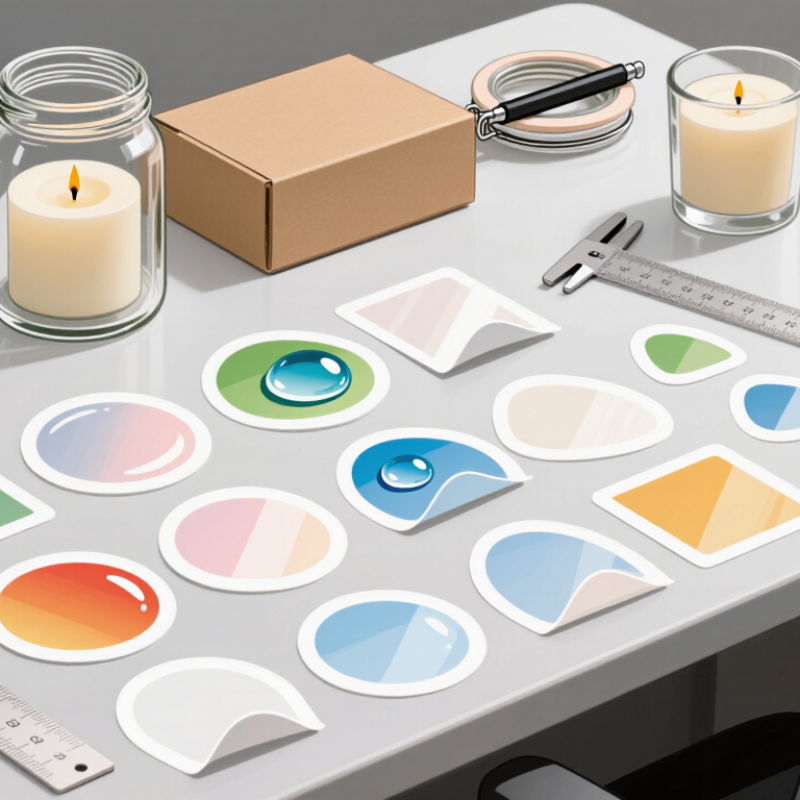
Clear decorative stickers are transparent adhesive designs printed on film, usually vinyl or PET. They add pattern, text, or small illustrations without covering the surface beneath. Unlike opaque stickers, they let glass, paper, wood, or colored packaging remain visible. A white ink layer can improve bright colors, but it reduces the see-through effect. This detail matters when buyers want a genuinely transparent appearance.
Wholesale buyers often use them on candle jars, gift boxes, notebooks, glass bottles, and retail packaging. They can decorate a product seal, mark a seasonal collection, or create a neat window graphic. Clear stickers also work well for handwritten packaging because the background stays visible. Small sizes suit envelopes and sample packs. Larger designs need careful handling during application.
Material selection should match the surface and expected use. Glossy film gives sharper color, while matte film feels softer and hides fingerprints better. Buyers should request samples and test adhesion, peeling, print clarity, and resistance to light or moisture. Clean, dry surfaces produce better results. Dust is unforgiving. In real purchasing work, the first sample is rarely perfect; thin lines may disappear, and dark packaging can weaken the design. Asking for revised proofs prevents expensive bulk mistakes. Some removable adhesives may still leave slight residue after long storage, so testing remains essential.
Clear decorative stickers are transparent adhesive graphics used to decorate, label, personalize, or add branding space while allowing the surface beneath to remain visible.
The chart compares general application suitability for three common clear sticker formats: clear vinyl, transparent PET, and static-cling film. Scores use a practical 1–5 buying guide, where 5 indicates strong suitability. Clear vinyl is a versatile choice for packaging, laptops, and promotional products; transparent PET is well suited to moisture-prone surfaces and durable labels; static-cling film is useful for temporary window decoration because it can be removed without permanent adhesive.
Top Clear Decorative Stickers for Wholesale Buyers?
Clear sticker materials should match the product, surface, and sales environment. BOPP suits bottles, jars, and flexible packaging because it resists moisture and offers a clean no-label look. PET provides stronger dimensional stability for cosmetics, electronics, and premium gift boxes. It also tolerates heat better during filling and transport. PVC can perform well outdoors, but buyers should review recycling goals and local disposal requirements before ordering. The choice is not always obvious.
Smithers’ 2024 label market outlook projects global label demand to approach US$60 billion by 2028. This growth increases pressure on wholesalers to specify materials accurately, not simply choose the lowest unit price. A clear film can still look cloudy on textured glass. Adhesive performance also changes with oil, condensation, and low temperatures.
In sampling work, I have seen attractive stickers lift at the bottle shoulder after refrigeration. That failure deserved better testing.
Tips:
Request samples on the actual container. Test rubbing, condensation, sunlight, and removal after 72 hours. For short campaigns, BOPP often balances cost and appearance. For long-term outdoor use, PET may justify its higher price. Check adhesive clarity under strong side lighting; tiny bubbles become highly visible. Data from FINAT’s 2024 market reporting also shows continuing demand for pressure-sensitive labels in European packaging, but material selection still depends on application details, not market volume alone.
Top Clear Decorative Stickers for Wholesale Buyers?
How to Compare Adhesive Quality, Printing, and Transparent Finishes?
For wholesale buyers, adhesive quality begins with the intended surface. Test stickers on glass, coated paper, plastic, and lightly textured packaging. A strong adhesive should bond evenly without edge lifting after 24 to 72 hours. Check removal, too. Some adhesives hold well but leave residue or tear during application. Temperature and humidity can change performance. Request samples from the actual production batch, not only a showroom sample.
Printing quality needs close inspection under normal store lighting. Look for sharp small text, smooth color areas, and accurate registration around fine shapes. Rub the printed surface gently with a dry cloth. Then test light moisture exposure. Ink that smears quickly may create avoidable returns. Transparent materials can make colors appear softer than expected. Ask whether white ink is used beneath selected areas. Without it, pale artwork may nearly disappear on dark or colorful surfaces.
Transparent finishes deserve a practical comparison. Gloss film gives stronger shine but can reveal fingerprints and glare. Matte film reduces reflections, yet it may slightly soften printed details. Inspect haze, bubbles, film thickness, and cut edges against a clear window. I once approved a sample that looked excellent on a white board. It looked weak on tinted glass. That mistake taught me to test the sticker where customers will use it. A small pilot order is often wiser than judging from photographs alone.
| Evaluation Dimension | Wholesale-Ready Benchmark | Acceptable Standard | How to Compare | Buyer Risk if Below Standard |
|---|---|---|---|---|
| Adhesive Type | Permanent or removable acrylic adhesive selected for the intended surface | Adhesive specification is clearly documented before production | Check whether the adhesive matches glass, plastic, paper, metal, or coated surfaces | Unexpected residue, lifting edges, or difficult removal |
| Peel Adhesion | Approximately 6–15 N/25 mm after 24–72 hours on clean glass or similar smooth surfaces | Approximately 3–6 N/25 mm for light-duty decorative use | Request a 180° peel test using the same surface, dwell time, and peel speed | Stickers may detach during storage, shipping, or normal handling |
| Initial Tack | Firm contact within seconds without requiring heavy pressure | Adheres after moderate hand pressure and remains stable after application | Apply to a clean test panel and inspect after 10 minutes, 24 hours, and 72 hours | Bubbles, edge lift, and higher application labor |
| Application Surface | Reliable on smooth, clean glass, acrylic, coated paper, and finished metal | Suitable for at least one specified smooth surface | Test on the exact substrate used by the customer; textured and dusty surfaces reduce adhesion | Inconsistent results across different retail or packaging surfaces |
| Clear Film Thickness | Approximately 50–100 microns for the clear face film, excluding liner | Approximately 40–120 microns depending on flexibility and durability needs | Confirm film and liner thickness separately with a micrometer or technical datasheet | Very thin film may wrinkle; thick film may look less seamless |
| Print Resolution | At least 300 dpi for standard graphics; 600 dpi preferred for fine text and line art | 300 dpi artwork output with readable text at the final size | Inspect small lettering, thin lines, registration, and edge sharpness at actual viewing distance | Blurry details, unreadable text, and higher rejection rates |
| Color Consistency | Consistent appearance across the same production batch; color tolerance defined in advance | No obvious shade difference under consistent lighting | Approve a physical proof and compare mass production under daylight or standardized lighting | Mixed cartons, inconsistent retail presentation, and customer complaints |
| White Ink Underlayer | Selective white ink for opaque areas while preserving transparency in uncovered regions | White ink available when color strength is needed on dark or colored surfaces | Check opacity, registration, and whether the white layer is applied only where specified | Dull colors, unintended transparent areas, or visible alignment errors |
| Transparent Finish | Optically clear gloss with low visible haze for a glass-like appearance | Clear enough for decorative use with no major clouding or yellow cast | Place the sticker on clear glass and inspect against a white and dark background | Milky appearance, reduced contrast, and lower perceived product value |
| Matte Finish | Uniform matte surface that reduces glare while maintaining clean printed edges | Even texture without visible streaks, scratches, or uneven coating | View under direct light and rub lightly to check surface uniformity and scuff resistance | Patchy appearance and visible handling marks |
| Water Resistance | Resists brief water exposure when paired with suitable film and ink technology | No immediate ink bleeding or film separation after a short water test | Wipe with a damp cloth, allow to dry, and inspect color, edges, and adhesion | Smearing, peeling, or damage during cleaning and humid storage |
| Temperature Performance | Typical acrylic systems operate across approximately −20°C to 80°C after full bonding | Suitable for normal indoor temperature and storage conditions | Confirm the adhesive supplier's minimum application and service temperatures | Curling, adhesive flow, or detachment during transport and seasonal changes |
| Cutting Accuracy | Clean edges with approximately ±0.5 mm registration tolerance for standard decorative shapes | No visible white edge, incomplete cuts, or difficult weeding | Review the outline, small internal cuts, and liner release on production samples | Slow application, damaged stickers, and inconsistent finished appearance |
| Release Liner | Smooth, flat liner with consistent release and no adhesive transfer | Sticker separates without tearing or excessive force | Peel samples by hand and check both small and large sticker formats | Curling, tearing, waste, and slower packing operations |
| Packaging and Storage | Flat-packed, moisture-protected, and stored away from direct sunlight and excessive heat | No blocking, curling, scuffing, or moisture damage on arrival | Request carton protection details and inspect samples after simulated storage | Damaged inventory, short shelf life, and avoidable claims |
Reference note: Performance varies with film construction, adhesive formulation, surface cleanliness, application pressure, temperature, and exposure conditions. Confirm final specifications with a physical production sample and documented test method.
For bulk buyers, design must work across many products, not only in a product photo. Clear backgrounds suit glass jars, matte boxes, notebooks, and colored mailers. According to Grand View Research, the global self-adhesive labels market was valued at approximately USD 49.9 billion in 2023. That scale suggests strong demand, but it also raises quality expectations. Buyers often prefer simple line art, botanical details, stars, initials, and small seasonal icons. White ink underprinting can make pale artwork visible on dark surfaces. It may also increase production cost.
Size affects both appeal and inventory risk. In wholesale testing, 1.5 to 3 inches usually offers flexible placement for packaging, envelopes, cards, and retail displays. Smaller stickers work well for seals and planners, while larger formats create stronger visual impact on shipping cartons. A Smithers report on the future of global labels highlights continued growth in premium and specialized labeling applications. Clear decorative stickers fit this trend when they combine attractive artwork with reliable adhesion and clean cutting.
Popular shapes include circles, arches, rounded rectangles, and custom silhouettes. Rounded edges reduce corner lifting during handling. Kiss-cut sheets are easier for retailers to display, while individual die-cut pieces support gift shops and event packaging. Buyers should request samples before placing large orders. Check transparency, color contrast, liner release, and resistance to moisture. One detail is easy to overlook: a beautiful design can fail when the adhesive leaves residue. Bulk purchasing rewards consistency, though not every “premium” finish performs equally well.
Top Clear Decorative Stickers for Wholesale Buyers?
Clear decorative stickers look simple, but wholesale quality varies widely. I inspect transparency under daylight and warm indoor light. A reliable supplier should provide recent samples, adhesive specifications, and production photos. Ask whether the film is PVC, PET, or another material. PET often feels cleaner and more stable, but it may cost more. Check print sharpness around tiny letters. Edges should remain smooth after peeling.
Pricing needs more than a unit quote. Request separate figures for artwork setup, proofing, packaging, shipping, and possible rework. Compare the same size, finish, quantity, and packing method. A low price can hide weak adhesive or excessive protective liners. I have found that sample approval prevents expensive surprises. Still, samples can flatter the final result. Ask for a production sample when the order is important.
Packaging should protect the clear surface from dust, scratches, and curling. Individual bags suit retail-ready packs, while paper sleeves may reduce material use. Confirm carton dimensions, inner quantities, labels, and moisture protection. Minimum order quantities deserve careful negotiation. A supplier offering 500 pieces may charge more per unit than one offering 5,000. Do not accept a large MOQ without testing demand. That sounds obvious, yet rushed buyers often overlook it. Request written tolerances for color, size, and quantity. Also confirm lead times during peak seasons, not only normal weeks.
BOPP works well on bottles, jars, and flexible packaging. It resists moisture. Its clear appearance supports a no-label look. Test it after refrigeration, because bottle shoulders can cause lifting.
PET offers stronger dimensional stability than many flexible films. It suits cosmetics, electronics, and premium gift boxes. It also handles heat better during filling and transport. The higher cost may be justified.
PVC can perform well outdoors. However, review recycling goals and local disposal requirements before ordering. Its use should match your sustainability plan. That decision is not always simple.
Apply samples to the actual container. Test glass, coated paper, plastic, and lightly textured surfaces. Check edge lifting after 24 to 72 hours. Also test removal and residue. Showroom samples can mislead.
Oil, condensation, humidity, and low temperatures can reduce adhesion. Test stickers after refrigeration and light moisture exposure. Rub the edges gently. Watch for bubbles or lifting.
Inspect small text under normal store lighting. Check sharp edges, smooth colors, and accurate registration. Rub the print with a dry cloth. Then add light moisture. Smearing can create returns.
White ink can strengthen pale artwork on dark or colorful surfaces. Without it, light colors may nearly disappear. Compare printed samples on the final surface. White backing is not always necessary.
Gloss film creates stronger shine but shows fingerprints and glare. Matte film reduces reflections but may soften fine details slightly. Inspect haze, bubbles, thickness, and cut edges. Look closely.
A small pilot order reveals problems that photographs cannot show. Test sunlight, rubbing, condensation, and removal after 72 hours. Check the sticker beside a clear window. I once approved a sample on white board. It looked weak on tinted glass.
Clear Decorative Stickers are versatile adhesive labels made with transparent films that allow background surfaces, colors, and textures to remain visible. They are commonly used for product packaging, gift presentation, stationery, promotional materials, event decoration, and retail displays. Wholesale buyers should compare materials such as clear vinyl, polyester, and paper-based films according to durability, flexibility, moisture resistance, and intended application. Adhesive performance is equally important, including initial tack, long-term bonding, clean removal, and compatibility with glass, plastic, paper, or coated surfaces.
When sourcing in bulk, buyers should review print sharpness, color accuracy, opacity, gloss or matte finishes, and the quality of transparent areas. Popular options include custom logos, seasonal artwork, minimal patterns, lettering, and practical labels in round, square, die-cut, or custom shapes. Before placing an order, evaluate supplier consistency, sample quality, production capacity, packaging protection, lead times, pricing tiers, and minimum order quantities to ensure reliable quality and cost-effective purchasing.