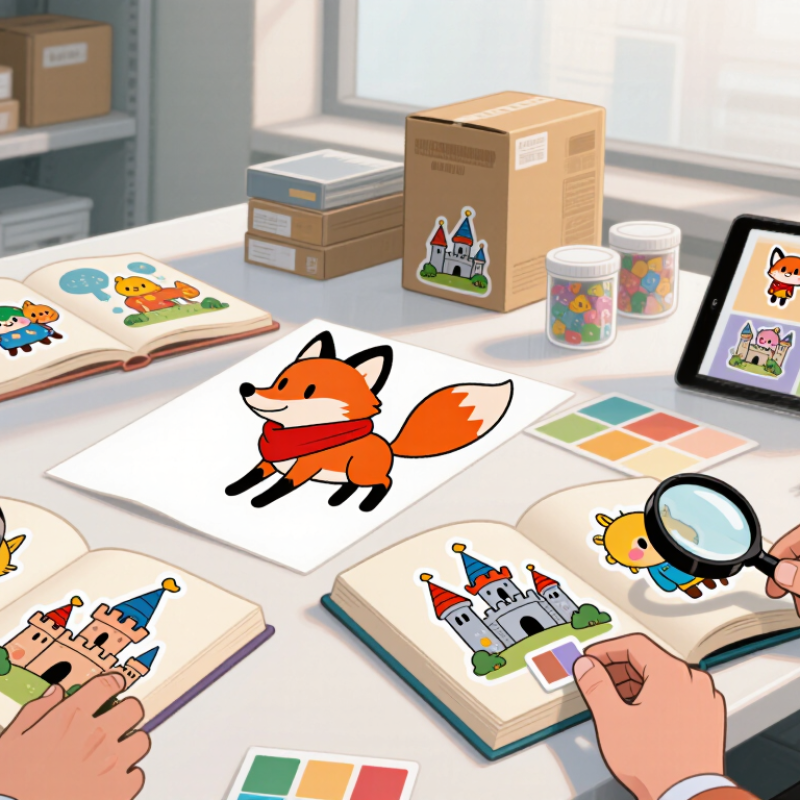
Buying Storybook Sticker Sets wholesale can look simple: choose a charming theme, compare prices, and place an order. The real work is in the details. A fox with a bright red scarf may look crisp on a sample sheet, yet arrive blurred across a full production run. Buyers should check print consistency, adhesive quality, sheet size, packaging, minimum order quantities, and delivery timing before committing. Small details matter.
Market reports offer useful context, but they cannot predict demand for every shop. Circana reported that toy sales increased 7% across 12 major markets in 2024. That broader growth suggests opportunity, not a guarantee that sticker sets will sell quickly. The U.S. Census Bureau also reported that e-commerce accounted for 17.9% of U.S. retail sales in the fourth quarter of 2024. For online sellers, clear product photos and accurate descriptions can help shoppers judge what they are buying. For physical stores, compact packaging and easy-to-browse designs may matter more. Neither point replaces firsthand testing.
These ten tips focus on practical checks wholesalers can make before ordering, from requesting production samples to reviewing reorder terms. Ask how colors are matched, whether stickers peel cleanly, and how damaged stock is handled. Keep written specifications. A missed detail can be expensive. Wholesale buying still involves judgment, and no report can remove every risk.
Storybook sticker sets sit between stationery, giftware, and children’s activity products. Buyers often look for recognizable scenes, clear color, and sheets that are easy for small hands to peel. For wholesalers, that means checking more than the illustration. Ask about sheet size, adhesive strength, print consistency, and how designs are packed. Small details matter.
Grand View Research’s Stationery Products Market report estimated the global market at $105.5 billion in 2023. This broad figure includes many stationery categories, not sticker sets alone. Treat it as market context, not proof of sticker demand. A sample order can reveal more: inspect cut lines, rub a sticker gently, and check whether fine storybook details remain readable.
Online sales also shape how buyers discover wholesale ranges. The U.S. Census Bureau reported estimated U.S. e-commerce sales of $1.19 trillion in 2024, or 16.1% of total retail sales. That is a channel indicator, not a sales forecast for stickers. Still, searchable product photos and accurate pack counts help buyers compare offers. Wholesale pricing should account for artwork, packaging, and order quantities. A low unit cost can hide weak paper or inconsistent cutting. I would not assume one design suits every shop.
Illustrative unit-cost index by order quantity (100 units = index 100). This example shows how larger orders may reduce per-set costs; it is not observed market pricing. Request written quotes and compare quality, shipping, and minimum order quantities.
Before requesting wholesale quotes, define who will use the stickers and who will pay for them. A preschool gift buyer needs larger shapes and simple story scenes. A school-age reader may prefer character-building details, maps, or visual puzzles. Bookshops, teachers, and parents also have different budget limits. Write down the age range, setting, and expected price per pack. Keep it tangible.
Theme choices work best when they match how children engage with books. The 2023 Kids & Family Reading Report found that 46% of U.S. children ages 6–17 said they loved or liked reading books for fun. That finding supports story-linked designs, not just decorative images: woodland clues, familiar fairy-tale objects, or stickers that invite children to retell a scene. Still, reading interest varies by age and household, so test two or three themes with actual buyers before committing to a large run. I still get this wrong sometimes.
Translate those choices into a clear order brief. Specify sticker size, sheet count, finish, packaging, target delivery date, and acceptable color variation. Ask suppliers for samples and confirm the minimum order quantity before approving artwork. A glossy finish can make bright illustrations pop, but tiny details may become hard to peel. Small tests help. Compare sample sheets with the hands using them, then adjust quantity and design to fit your audience rather than ordering extra stock on instinct.
Illustrative buying guide. Confirm current pricing, minimum order quantities, product specifications, and safety requirements directly with each supplier.
| Tip | Buying decision | Audience or use case | Example specification | Wholesale requirement to check |
|---|---|---|---|---|
| 1 | Define your primary audience | Parents, teachers, librarians, or adult journaling customers may value different designs and formats. | For classroom use, consider easy-to-handle sheets and a variety of characters; for journals, consider smaller decorative stickers. | Ask whether the assortment and packaging can be tailored to your customer group. |
| 2 | Choose an age range | Young children may need larger, simpler designs; older children and adults may prefer finer detail. | Specify intended age range, sticker dimensions, and whether small pieces are present. | Request applicable product-safety documentation and required warnings for the markets where you will sell. |
| 3 | Select a clear story theme | Gift buyers and activity providers often look for recognizable, cohesive themes. | Examples include woodland adventures, undersea exploration, fairy-tale castles, or space journeys. | Check that the quoted set includes the agreed theme throughout, rather than unrelated mixed designs. |
| 4 | Review the artwork and story mix | A balanced set can support imaginative play, decorating, and simple storytelling activities. | Request a mix of characters, scenery, objects, and story-related details in the sample assortment. | Approve a proof or physical sample before confirming a larger production run. |
| 5 | Compare format and contents | Retail shelves, party favors, and subscription boxes may have different size and quantity needs. | Record sheet count, approximate sticker count, sheet dimensions, and finished package dimensions. | Ensure the product specification states the contents per retail set and the units per wholesale carton. |
| 6 | Set order quantities and assortment | A first order should reflect expected demand, available storage, and the number of themes you plan to test. | Ask for the minimum order quantity (MOQ) per design, assortment, and production run. | Confirm whether the MOQ applies to each theme or can be shared across several approved designs. |
| 7 | Check materials and adhesive performance | Customers may use stickers on paper, notebooks, or activity sheets, so surface compatibility matters. | Request details on paper or film material, finish, backing, and intended use of the adhesive. | Test samples for print clarity, peeling, residue, and performance on representative surfaces. |
| 8 | Plan packaging and labeling | Gift shops and online sellers may need packaging that protects sheets and clearly shows the contents. | Specify individual pack format, barcode area if needed, carton quantity, and any required language. | Confirm packaging materials, labeling responsibilities, and whether custom packaging changes the MOQ or lead time. |
| 9 | Calculate the full landed cost | Wholesale unit price alone does not show the final cost of bringing goods to your sales location. | Include product price, samples, setup charges, packaging, freight, duties, taxes, and handling where applicable. | Request a written quotation with currency, shipping terms, payment schedule, and quotation validity period. |
| 10 | Confirm timing, inspection, and reorders | Seasonal promotions and steady retail sales both benefit from predictable replenishment. | Agree on production lead time, dispatch estimate, inspection process, and reorder contact procedure. | Clarify how defects or quantity discrepancies are reported and whether repeat orders have different lead times. |
A reliable wholesale supplier should answer specific questions, not just promise “premium quality.” Ask where the stickers are produced, how batches are checked, and whether material or color changes are disclosed. Request current test reports and safety documents relevant to your sales market and the product’s intended age group. Check that packaging carries clear age guidance when needed. Keep records of supplier responses; vague answers are worth a pause.
Order samples before committing. Look closely at cut edges, print alignment, and tiny details such as a character’s eyes. Rub the printed surface with a clean, dry cloth, then peel stickers from the backing slowly. They should lift without tearing or leaving heavy residue. Try them on paper and a smooth surface. Adhesion can vary. A polished sample may not represent every production run, so ask how the supplier compares bulk goods with approved samples.
Safety needs more than a reassuring label. Ask about paper, adhesive, and ink composition, plus any relevant testing for the intended use. Small decorative pieces may not suit very young children. Check warnings and instructions for clarity, and confirm that cartons protect sheets from moisture and bending. I would not rely on appearance alone; even bright, tidy printing can conceal inconsistent materials. Ask for batch identification and a process for handling defects before placing a large order.
When comparing wholesale storybook sticker sets, look beyond the price printed on a quote. Divide the total cost by the number of usable sticker sheets, then check whether packaging, shipping, and setup fees are included. A low unit price may hide thin paper or colors that look dull beside a sample. Small details matter. Request the same specifications from each supplier so the comparison stays fair.
Minimum order quantities can change the real cost quickly. A supplier may offer a better rate at 1,000 sets, but that only helps if you can store and sell them. Compare the price breaks at several quantities, such as 100, 300, and 1,000 sets. Ask whether a sample order is available before committing to a larger run. That adds up. I would also leave room in the budget for a few misprints or damaged packages; the exact allowance is easy to overlook.
Customization affects both price and production time. Check whether custom illustrations, character poses, foil details, or shaped cuts carry separate fees. Ask for a digital proof, and confirm the number of revisions included. Ask for a proof. Compare the colors and cut lines against your intended use, not just a screen preview. Custom work can make a set feel special, but it may not justify the cost for every design. Sometimes a simpler palette is clearer. Request written details for lead time, material, and final size before approving the order.
Tip 1 — Plan shipping around the full carton, not just the sticker packs. Ask suppliers for carton dimensions, gross weight, and packing quantities before confirming freight. A small sample shipment can reveal bent corners or loose rolls. Check the delivery window against your launch date, and leave a few days for delays. They happen.
Tip 2 — Store sets flat, dry, and away from direct sunlight. Use labeled bins so story themes and age ranges are easy to locate. Keep opened cartons separate from sealed stock; it makes counts more reliable. Avoid stacking heavy boxes on top. Sticker sheets can curl, and damaged packaging may be harder to sell.
Tip 3 — Track each design with a simple inventory sheet. Record units received, units sold, damaged packs, and the reorder date. Set a minimum stock level based on sales pace and supplier lead time, then review it weekly during busy periods. I’ve found that estimates can be wrong, especially for new themes. Start with a cautious order, compare actual sales after a few weeks, and adjust. Don’t rely on memory.
Match the theme to the child’s age and reading habits. Woodland clues, fairy-tale objects, or scene-retelling stickers can connect with books. Test two or three ideas with buyers. I still misjudge preferences sometimes.
Specify sticker size, sheets per set, finish, packaging, delivery date, and acceptable color variation. Include the target age range and expected price per pack. Keep it concrete.
Ask where the stickers are made, how batches are checked, and whether material changes are disclosed. Request current, relevant test reports and safety documents. Vague answers deserve a pause.
Check cut edges, print alignment, and tiny details like a character’s eyes. Rub the surface with a clean, dry cloth, then peel a sticker slowly. Try it on paper and a smooth surface.
A polished sample may not match every production run. Ask how bulk goods are checked against approved samples. Adhesion can vary.
Divide the total cost by usable sticker sheets. Check whether packaging, shipping, and setup fees are included. Request matching specifications from each supplier. Small details matter.
Compare prices at several quantities, such as 100, 300, and 1,000 sets. Consider storage space and likely sales, not just the lower unit price. Leave room for damaged packages or misprints.
Ask about fees for illustrations, foil details, and shaped cuts. Confirm digital proofs, included revisions, lead time, materials, and final size in writing. A simpler palette may read better.
Buying Storybook Sticker Sets wholesale can be a practical way to stock a shop, classroom, or creative business with appealing products. Start by learning how these sets are sold in the wholesale market, then identify your intended customers and choose themes that suit their interests. Estimate the quantity you need and consider how frequently you expect to restock so your order fits your goals.
Before purchasing, assess suppliers, request product samples when possible, and check the stickers’ print quality, materials, and relevant safety information. Compare total costs, minimum order quantities, and customization options rather than focusing on unit price alone. Finally, account for shipping timelines and costs, and plan how to store and track your inventory. Careful preparation can help you select suitable products, control expenses, and keep popular designs available without ordering more than you can manage.