Designed & illustrated in Santa Monica since 2007 · Trade & wholesale program
0%

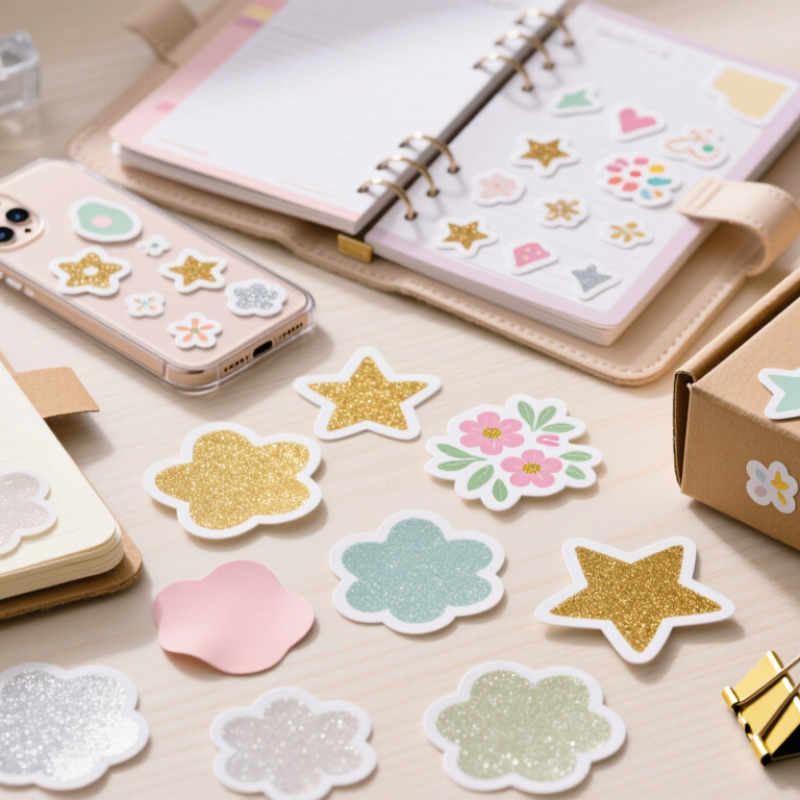
Paper Flake Stickers are small paper-based decorations designed to add texture, color, and personality to everyday surfaces. They often appear as irregular flakes, confetti-like pieces, or themed shapes. Unlike ordinary labels, they are usually chosen for visual expression rather than identification. Think journals, gift boxes, phone cases, planners, greeting cards, and classroom projects.

Their commercial potential reflects wider growth in decorative labels and paper packaging. Grand View Research valued the global self-adhesive labels market at approximately USD 52.8 billion in 2023, with continued expansion expected through the decade. Smithers’ label-printing research also highlights personalization, short production runs, and premium finishes as important market trends. These findings help explain why small decorative formats remain useful for brands, creators, and event organizers. A bakery might place a matte flake sticker on a kraft box. A stationery designer might layer metallic pieces across a weekly spread. Small details matter.

Still, the term can be misleading. Not every Paper Flake Stickers product uses the same paper, adhesive, or coating. Some are removable, while others leave residue. Recycling suitability may also change when glitter, foil, plastic film, or strong adhesive is added. Buyers should check material specifications, adhesive performance, and supplier certifications. FSC-certified paper can support responsible sourcing, but certification does not automatically prove full recyclability. That distinction deserves attention. Used thoughtfully, these stickers can support decoration, branding, organization, and hands-on learning without making the product feel excessive. Their value depends on fit, finish, and honest material claims.
What Are Paper Flake Stickers Used For?

What Paper Flake Stickers Are: Materials, Adhesives, and Flake Design

What Are Paper Flake Stickers Used For?

Paper flake stickers are decorative labels made from thin paper pieces, usually cut into irregular shapes. Their lightweight structure suits journals, gift wrapping, greeting cards, scrapbooks, and classroom projects. Some designs resemble tiny leaves, stars, petals, or confetti. The flake shape adds texture without making the surface feel bulky.

The paper may have a matte, recycled, coated, or lightly textured finish. Matte paper accepts handwriting well, while coated paper gives brighter colors and sharper details. Adhesives also affect the user experience. Removable glue works well for planners and temporary displays. Permanent adhesive is better for envelopes, packaging, and smooth craft surfaces. However, adhesion can weaken on dusty, oily, or uneven materials. I still test a small area first. The result is not always perfectly smooth.

Tips: Press each flake for several seconds, especially around narrow edges. Store unused stickers flat and away from humidity. For layered designs, place larger flakes first, then add smaller pieces. Leave some open space; crowded patterns can hide the individual shapes. On textured paper, stronger adhesive may help, but it can also tear delicate surfaces during removal. A quick material test prevents disappointing results.

What Are Paper Flake Stickers Used For?

Paper flake stickers are commonly used for scrapbook decoration, journaling, gift packaging, card making, and craft projects. Their face stock is usually paper, their adhesive may be permanent or removable pressure-sensitive glue, and their irregular flake-shaped cuts create a layered decorative effect.

The chart compares common paper basis-weight reference points used when selecting sticker face stock. Lower basis weights are generally easier to fold and layer, while higher basis weights provide a more substantial feel for packaging, cards, and dimensional craft designs. Actual durability depends on the paper finish, adhesive, surface, and flake size.

How Pressure-Sensitive Adhesives Make Paper Flake Stickers Stick

Paper flake stickers are useful for decorating notebooks, gift envelopes, calendars, scrapbooks, and study cards. Their uneven edges create a handmade appearance, especially when layered over plain paper. They can also mark important pages without adding much weight. Some people use them to organize notes by color or shape. They are simple tools.

Their sticking power comes from a pressure-sensitive adhesive, or PSA. This adhesive stays slightly tacky at room temperature. When a finger presses the sticker, the adhesive spreads into tiny surface gaps. More contact improves the bond through molecular attraction and gentle mechanical grip. No water or heat is required. Pressure matters. A firm, even press usually works better than a quick touch.

The surface condition matters just as much. Paper should be dry, clean, and free from loose fibers. Dust, oil, or heavy texture can prevent full contact. On rough cardboard, small edges may lift because the adhesive cannot fill every gap. Warm conditions may increase tack, while cold conditions can make the sticker less flexible. In practical use, I sometimes press too lightly and blame the sticker too quickly. Waiting a few seconds and rubbing the center outward often helps. Still, paper flake stickers are not permanent repairs, and repeated handling can weaken their edges. Testing one sticker on spare paper is a sensible habit.

What Are Paper Flake Stickers Used For? - How Pressure-Sensitive Adhesives Make Paper Flake Stickers Stick

Application or Factor How Paper Flake Stickers Are Used Role of the Pressure-Sensitive Adhesive Typical Performance Considerations
Product packaging Decorating paper bags, cartons, mailers, gift boxes, and small packages. The adhesive bonds the sticker to common packaging surfaces when pressure is applied, without requiring heat or liquid activation. Best results generally occur on clean, dry, smooth, and lightly textured paperboard or paper surfaces.
Branding and promotional decoration Adding logos, messages, seasonal graphics, or decorative accents to printed materials and packaging. A uniform adhesive layer helps the sticker remain attached while preserving a clean, low-profile appearance. Adhesion depends on surface energy, contact area, pressure, and the time allowed for the bond to develop.
Scrapbooking and paper crafts Creating layered artwork, borders, cards, journals, collages, and textured decorative designs. The pressure-sensitive layer provides immediate tack, allowing pieces to be placed without liquid glue that could wrinkle paper. Paper-to-paper bonding is usually easiest when both surfaces are free from dust, oil, and loose fibers.
Event and gift decoration Personalizing invitations, envelopes, favor boxes, wrapping paper, and thank-you cards. The adhesive makes application fast and clean because it is activated mainly by firm contact pressure. Removal may lift paper fibers or leave residue, especially on porous or uncoated paper.
Organization and labeling Marking folders, notebooks, storage boxes, documents, and handmade products. The adhesive maintains contact between the label and substrate through tack, wet-out, and cohesive strength. Label life is affected by handling, abrasion, humidity, temperature, and the condition of the substrate.
Paper surface compatibility Commonly applied to paper, cardstock, paperboard, envelopes, and other porous fiber-based materials. The adhesive flows into small surface irregularities, increasing the real contact area between the sticker and the substrate. Very rough, dusty, waxed, oily, or heavily coated surfaces can reduce contact and weaken adhesion.
Pressure application Users typically press the sticker from the center outward to remove air pockets and improve contact. Pressure promotes adhesive wet-out and helps the adhesive conform to microscopic surface features. Insufficient pressure can leave gaps, while even pressure generally produces a more reliable bond.
Initial tack and bond growth Supports quick application in crafting, packaging, labeling, and decoration. Initial tack helps the sticker hold shortly after placement; adhesion may continue to build as the adhesive makes closer contact over time. Immediate holding strength and final holding strength are different properties and should not be treated as identical.
Temperature and humidity Used mainly for indoor or protected applications unless the construction is specifically designed for harsher conditions. Temperature changes can alter adhesive softness and flow, while moisture can affect paper fibers and the adhesive bond. Store and apply stickers in a clean, dry environment and follow the material supplier's recommended conditions.
Removal and repositioning May be repositioned briefly during application when the adhesive is designed for removable use. Removability depends on adhesive formulation, dwell time, pressure, substrate strength, and the angle and speed of removal. Permanent constructions may tear paper, transfer adhesive, or leave fibers behind when removed.
End-of-life considerations Used on paper items that may later enter reuse, recycling, composting, or general waste streams. The adhesive layer becomes part of the overall material system and can influence repulping or separation processes. Recyclability depends on the complete sticker construction, adhesive chemistry, local recycling rules, and the amount of sticker material present.

Where They Are Used: Packaging, Retail, Crafts, Events, and Education

Paper flake stickers add a light, tactile detail to everyday packaging.

I have used them on mailer boxes, tissue wraps, and small product sleeves. Their scattered shape makes plain packaging feel more personal without adding much weight. They can mark seasonal releases, handmade goods, or gift orders. However, the adhesive should match the surface. Smooth cardboard holds well, while dusty or textured paper may cause lifting.

In retail, paper flake stickers help draw attention to price tags, display cards, and limited-quantity notices. Their irregular edges create visual movement near a product label. Store teams can also use them to separate collections or guide customers toward featured items. A balanced design matters. Too many flakes can make important information difficult to read. Clear contrast and modest placement usually work better than decoration everywhere.

Craft makers use paper flakes for scrapbooks, journals, cards, and gift tags. Event planners may place them on invitations, welcome bags, table cards, or memory books. In classrooms, teachers can use them as reward markers, sorting pieces, or prompts for collage activities. I have found that children enjoy choosing shapes, though cleanup takes longer than expected. For dependable use, check the paper source, adhesive strength, and disposal instructions. Some finishes resist recycling, so a beautiful sticker may create an avoidable waste problem. Testing one sample first is sensible.

What EPA’s 2022 68.2% Paper-Recycling Rate Means for Sustainability

Paper flake stickers add texture to scrapbooks, gift tags, classroom projects, and lightweight packaging. They usually contain a paper face, printed ink, and pressure-sensitive adhesive. Their environmental value depends on the complete material, not appearance alone.

The U.S. EPA reported a 68.2% paper and paperboard recycling rate in its 2022 data release. This figure shows strong recovery, but it does not guarantee that every sticker enters a recycling stream. Adhesives, plastic coatings, glitter, and laminated layers may complicate sorting. The American Forest & Paper Association reported about 46 million tons of paper recovered in 2022. That volume reflects real progress, yet small decorative pieces can still become sorting residue. My practical experience is simple: plain paper stickers perform better than shiny, heavily layered designs. Even then, local facility rules differ. The number is encouraging. It is not permission to ignore material design.

Tips: Choose uncoated paper flake stickers with water-based inks when possible. Apply them to clean paper surfaces, not plastic or food-stained packaging. Avoid foil, glitter, and thick plastic films. Before recycling, check your local program’s accepted-material list. A sticker may look recyclable while its adhesive causes rejection. That uncomfortable detail deserves more attention.

How to Select Them: Size, Finish, Adhesion, Durability, and Compliance

Paper flake stickers turn ordinary packaging, notebooks, cards, and gift boxes into tactile visual pieces. Their irregular edges suggest handmade quality, but selection needs more than appearance. A 2024 Smithers market analysis describes pressure-sensitive labels as a major, expanding label category, increasing demand for reliable adhesive performance.

Choose the size according to the surface and reading distance. Small flakes suit envelopes and product seals; larger pieces work better on cartons or displays. A matte finish hides fingerprints and photographs softly. Gloss improves color contrast but can reflect strong lighting.

Adhesion must match the substrate. Smooth coated paper needs a different adhesive balance than recycled, textured board. Test after 24 hours, then again after exposure to heat, moisture, and handling. Real use is less forgiving.

Tips: Request samples first. Check edge lifting, color rub, and residue. For frequently touched items, select thicker paper and protective finishing. Durability should fit the product’s life, not exceed it unnecessarily. The U.S. EPA reported a 46.2% paper and paperboard recycling rate in 2022, but stickers can complicate fiber recovery. Confirm local recycling guidance before making environmental claims. For food-related packaging, verify ink, coating, and adhesive suitability through supplier documentation and applicable migration standards. Compliance paperwork may feel tedious. It prevents expensive assumptions.

FAQS

What are paper flake stickers made from?

They usually contain thin paper, printed ink, and pressure-sensitive adhesive. Some have matte, recycled, coated, or lightly textured surfaces.

Where can paper flake stickers be used?

Use them in journals, gift wrapping, greeting cards, calendars, scrapbooks, and classroom projects. They add texture without much bulk.

How do pressure-sensitive adhesives work?

Finger pressure spreads the adhesive into tiny surface gaps. A firm, even press usually creates better contact.

Which surfaces work best for these stickers?

Clean, dry, smooth paper works best. Dust, oil, loose fibers, and heavy texture can weaken the bond.

Can paper flake stickers be removed easily?

Removable adhesive suits planners and temporary displays. Stronger adhesive may tear delicate paper during removal.

How should layered flake designs be arranged?

Place larger flakes first, then add smaller pieces. Leave open space so each leaf, star, or petal remains visible.

How should unused stickers be stored?

Keep them flat and away from humidity. Moisture can affect the paper and adhesive.

Are paper flake stickers recyclable?

It depends on local recycling rules and the complete material. Plain paper performs better than glittered, laminated, or heavily coated designs.

What makes a sticker environmentally preferable?

Choose uncoated paper and water-based inks when possible. Avoid foil, glitter, and thick plastic films.

Why should I test one sticker first?

Adhesion is not perfectly predictable. Test a small area before decorating valuable paper or uneven cardboard.

Conclusion

Paper Flake Stickers are decorative labels made from paper-based materials cut into distinctive flake-like shapes. They typically use pressure-sensitive adhesives, allowing them to bond when firm pressure is applied without water or heat. Their design can include different sizes, colors, textures, and finishes, while adhesive strength may range from removable to permanent. This flexibility makes them useful for packaging, retail labeling, craft projects, event decorations, classroom activities, and educational displays.

Their paper composition can also support sustainability goals when responsibly sourced and properly disposed of. The EPA’s reported 68.2% paper-recycling rate in 2022 highlights the importance of choosing recyclable materials and avoiding unnecessary coatings or mixed components. When selecting Paper Flake Stickers, consider the intended surface, label size, finish, adhesion level, exposure to moisture or handling, and required durability. It is also important to review recycling guidance, material disclosures, and applicable compliance requirements to ensure the stickers are suitable for their planned use.


Clara

Clara

Clara is a dedicated marketing professional with a deep understanding of the company’s products, customers, and industry landscape. Through her clear, practical, and insight-driven writing, she regularly contributes expert articles to the company website, helping readers better understand product......